.webp)
With smart technology, you can actively control the cleaning process and stay ahead of breakdowns more often. For the technical department, cleaning is therefore no longer an afterthought: misuse, overload and lack of insight lead directly to wear, breakdowns and downtime. By approaching cleaning technology and monitoring as a whole, you make maintenance more plannable and prevent ad hoc interventions.
In this article you will find out where things go wrong in practice and which technical measures help to maintain control over use, consumption and reliability.
Cleaning is also a technical process
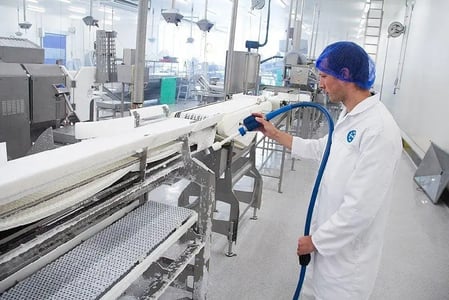
Cleaning systems consist of more than hoses and valves. They are part of a larger whole of:
- booster units;
- dosing systems for chemicals;
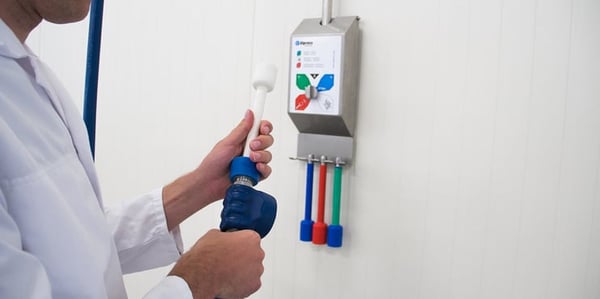
- satellites and supply points;
- piping, couplings and sensors;
- and increasingly: software and cloud monitoring.
When all this is misused or inadequately monitored, not only hygiene risks arise, but also technical problems: wear and tear, breakdowns and unexpected downtime.
Where do things most often go wrong in practice?
Most problems arise not from one big mistake, but from repetition of small deviations.
Improper use of facilities.
Employees use functions for which they are not trained or which are not permitted at the time. Think of chemistry use during production or prolonged flushing without necessity.
Overloading of systems.
Excessive water withdrawals, prolonged use of booster units, or improperly set dosages cause additional wear and failures.
Lack of insight
The technical department often only sees in retrospect that something has gone wrong, for example when an installation fails or when maintenance is required. Without data, the cause remains guesswork.
Manual intervention costs time
Without automatic signaling, you have to respond to reports from others, often too late and without context.
What technical measures help prevent errors?
Smart technology allows you to actively control the cleaning process instead of just reacting.
Rights and restrictions
You can determine:
- who can use which functions;
- at what times certain functions are available;
- Which agents may or may not be used during production.
This prevents chemistry from being used at times when it is unsafe to do so.
Automatic blocking
In case of deviations, the system can intervene, for example by:
- shutting down in case of extreme water consumption;
- blocking chemistry in case of incorrect configuration;
- stopping processes in case of abnormal settings.
This helps prevent damage to installations and reduces risks in the process.
Real-time notifications in case of deviations
When you choose eCloud, you can receive notifications in the event of:
- malfunctions;
- abnormal usage;
- exceeding set limits.
Then you don't have to wait for someone to call, but can identify and make adjustments earlier.
From reactive to preventive management
The difference is in the way you work: from reacting to incidents to steering by patterns.
With data you can see earlier:
- Which supply points give structural problems;
- Where wear and tear occurs more quickly;
- which settings more often lead to error messages;
- and when maintenance can be logically planned.
This makes maintenance predictable and plannable, rather than ad hoc.
Less downtime, more peace of mind
When the cleaning process is technically under control:
- the number of breakdowns decreases;
- Unscheduled maintenance decreases;
- collaboration with QA improves;
- and there is more peace and quiet within the technical department.
You know what is happening, why it is happening and when to intervene.
Smart cleaning as part of your technical strategy
Smart cleaning does not only mean saving or gaining insight, but most importantly: increasing reliability. By combining technology, data and process control, cleaning becomes a manageable part of your technical infrastructure.
Do you want to know how to set up your cleaning process in a smarter technical way? Use the selection chart and find out which configuration suits your situation.