.webp)
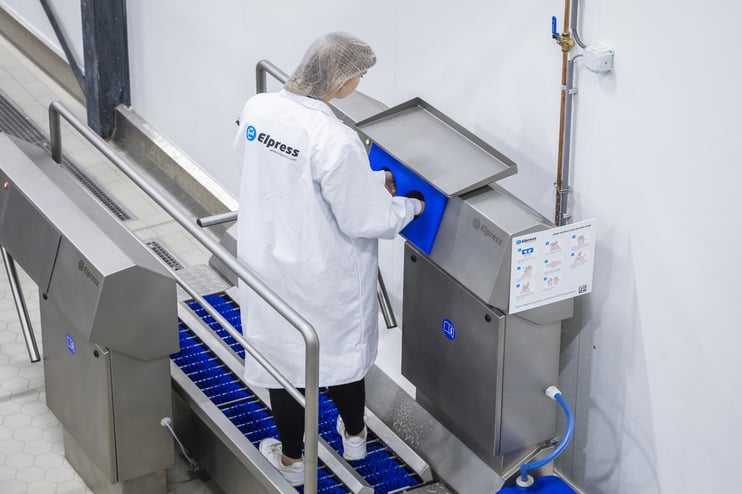
The impact of a hygienic entrance can be seen in any industry. Whether it is meat residue and bacteria in food processing, sticky dough in bakeries, metal particles in the automotive industry or pathogens in horticulture, a hygienic entrance reliably removes contamination and helps protect products, processes and crops.
The role of hygienic entrances in different types of contamination
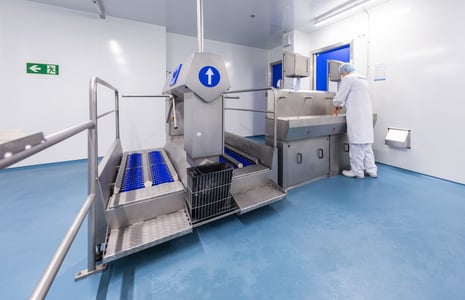
Hygienic entrances are used in various industries to control contamination and prevent it from spreading. They are especially important in the food processing industry because hygiene there directly affects the safety of products. Therefore, hygienic entrances are often an integral part of the production process.
A hygienic entrance is suitable for a wide range of contaminants, ranging from visible residues such as meat, sand and dough to invisible contamination at the bacterial level. However, the extent to which a hygienic entrance is effective depends greatly on the type of contamination, the environment in which it is applied and the way the entrance is set up and used.
Visible and invisible contamination are both crucial
Within production environments, both visible and invisible contaminants occur. Visible contamination, such as meat scraps, sand or dough, is moved through shoes or clothing and is directly observable. Invisible contamination consists of bacteria and microorganisms that are not visible but pose a significant risk to product safety.
Both types of contamination play an important role in contamination. Whereas visible contamination is mainly removed mechanically, invisible contamination requires disinfection. A hygienic entrance combines these functions, effectively separating dirty and clean areas.
Contamination by industry: what should you consider?
Food processing industry
In the food processing industry, visible and invisible contaminants almost always occur together. Organic residues such as meat, vegetables and powders are created during the processing of products. At the same time, these products also bring bacteria with them.
This creates a high contamination pressure, requiring both cleaning and disinfection. Hygiene locks are used here to remove contamination via personnel and to limit the transfer of bacteria between production areas
Bakery industry
Within the bakery sector, there is often a specific type of contamination: a combination of flour, dough and moisture. This leads to sticky and sticky substances that are difficult to remove.
Unlike many other applications, wet cleaning is not always the most effective solution here. Adding moisture can actually spread the contamination further. Therefore, dry brushing is often chosen in this sector, where the mechanical action of brushes loosens the contamination.
Automotive industry
In the automotive industry, the focus is less on bacterial contamination and more on material-related contamination, such as metal particles and stainless steel flakes.
Although hygiene locks can also be applied here, this requires extra attention. When these particles come in contact with cleaning agents and oxygen, oxidation can occur, eventually leading to rusting. Regular cleaning and prevention of accumulation are therefore essential to keep the system in good condition.
Horticulture
In horticulture, invisible contamination in particular is a critical factor. Bacteria and pathogens can spread quickly and cause major damage to crops.
A single contamination can be enough to affect an entire crop. This is why there is a strong emphasis on prevention in this sector. Hygiene locks ensure that personnel do not carry contamination from outside, thus helping to significantly reduce the chance of spreading.
Besides these sectors, Elpress is active in several other industries where hygiene and contamination control play a crucial role. Curious about what other industries we are active in? Take a look at the complete overview on our website.
What happens to contamination in a hygienic entrance?
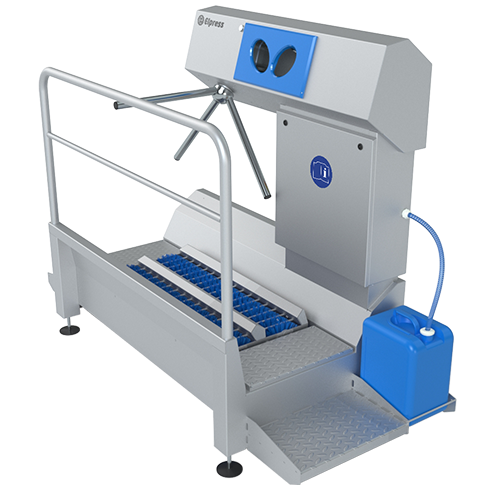
During operation of a hygienic entrance, contamination is loosened by brushes and collected in a collection tray after which it is usually discharged through a drainage system towards the sewer. To prevent blockages, filters hold back coarse particles such as food particles so that they can be manually removed. This contributes to the stable operation of the system. At the same time, regular maintenance remains essential.
Want to know more?
Would you like to know which hygienic entrance fits your situation and type of contamination best? Feel free to contact us!