.webp)
Personnel shortages are causing many industrial companies to rethink how they work. Recurring and physical tasks, such as cleaning crates, bins and trays, are especially difficult to get properly filled. This often puts extra pressure on employees and the process, even though these tasks are important to the day-to-day operations. In this blog you will read how companies can organize their processes smarter and become less dependent on manual work. We also explain why cleaning processes can be automated and what this means for continuity and quality.
Personnel shortage requires a different approach
The shortage of personnel is now a recognizable problem for many industrial companies. Vacancies often stay open longer and employees have to deal with a higher workload. Especially in environments where processes have to continue continuously, this can create challenges.
As a result, more and more organizations are looking at their way of working differently. Where it used to make sense to hire additional staff, the focus is now more often on working more efficiently and reducing reliance on manual work.
Repetitive work as a bottleneck
Repetitive work in particular is difficult to get properly filled. Consider, for example, the manual cleaning of crates, bins and trays. This work is often physically demanding and not very attractive. In a tight labor market, this makes it difficult to find and retain enough people.
Yet these processes are important for daily operations. If too few personnel are available, this can cause
- delays in the process
- differences in the quality of cleaning
- inefficient use of employees
It is precisely because these activities are so important, but at the same time difficult to fill, that they create pressure on the process. Companies are therefore increasingly looking for ways to set this up differently. The focus is therefore shifting from "more people" to "working smarter. By analyzing where time and capacity is lost, it becomes clear which steps can be set up more efficiently. Especially predictable and repeatable activities offer opportunities for this.
Automation of cleaning processes
Cleaning processes are a good example of work that can be automated. The cleaning of crates or bins often consists of fixed steps that are always performed in the same way. This is precisely why these processes are suitable for more efficient design.
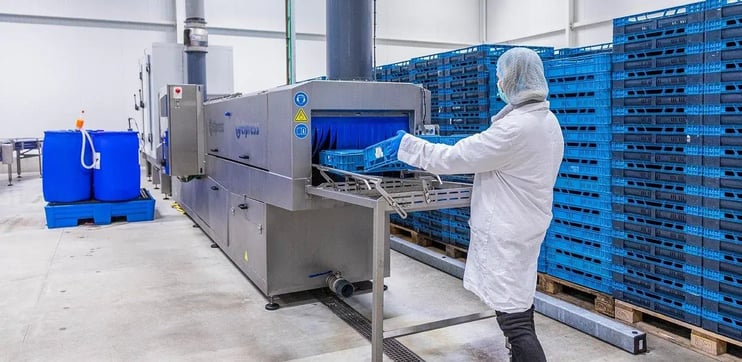
Crate washers play an important role here. These systems take over the cleaning of crates and bins, reducing the need for manual work. This makes companies less dependent on personnel while ensuring consistent cleaning quality. It also keeps the process running better even when fewer employees are available.
In practice, this means that employees spend less time on repetitive work. They can therefore be used more broadly within the company. Especially with larger volumes or a structural labor shortage, this can make a clear difference.
Responding to structural labor shortage
The labor shortage in the industry is not a temporary problem. Therefore, more and more companies are looking at how they can future-proof their processes. A good first step is to take a critical look at current working methods. For example, by asking questions such as:
- Where are repetitive and labor-intensive tasks located?
- Which processes are vulnerable to underutilization?
- Where can automation make the most difference?
Here, automation is not a goal in itself, but a way to make processes more stable and efficient. Cleaning processes are often a logical starting point because they consist of repeatable steps.
Want to know more?
Are you considering redesigning the cleaning process, but don't yet know what to look out for? Then download the checklist "Points to consider when purchasing a crate washer".
This checklist will give you insight into the most important issues when purchasing a crate washer, so you can make the right choices well prepared.