.webp)
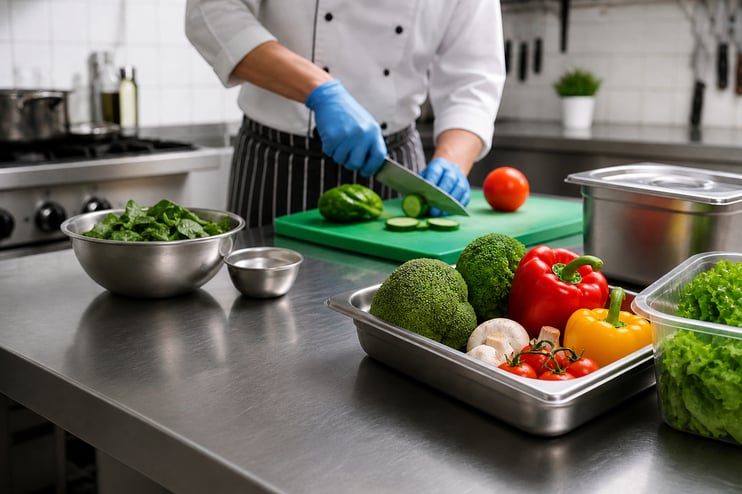
When you work with food and drink, food safety is essential. That is why HACCP guidelines play an important role within any company in the food sector. HACCP stands for hazard analysis and critical control points and is a systematic method of identifying potential hazards, analyzing risks and controlling them by establishing critical control points. These are moments in the process when you must intervene to guarantee the safety of food. By working according to the HACCP rules and a well-drafted HACCP plan, you not only meet the HACCP requirements, but also the guidelines of the Dutch Food and Consumer Product Safety Authority. The basic principles of HACCP help companies to structurally and demonstrably work safely within the kitchen.
Is HACCP in the kitchen mandatory?
Yes, in the Netherlands it is mandatory to work according to the HACCP guidelines when you work with food and beverages professionally. The Dutch Food and Consumer Product Safety Authority (NVWA) checks whether companies comply with the applicable food safety regulations. This means that you must have a properly functioning HACCP system within the company and that your processes are set up accordingly. Working according to HACCP is therefore not a choice, but a legal obligation that helps to ensure food safety and minimize risks.
The HACCP rules in the kitchen
Rule 1: Identify potential hazards in the kitchen.
The first step within the HACCP plan is to conduct a hazard analysis. This involves identifying all possible hazards that could affect food safety. Consider biological, chemical and physical hazards, such as bacteria, cleaning agents or foreign objects. By identifying these risks early, you can take targeted measures to prevent problems.
Rule 2: Identify the critical control points (CCPs).
After identifying the risks, determine the critical control points (CCPs), or critical control points. These are the steps in the process where you must intervene to control or prevent a risk. Consider, for example, the heating, cooling or storage of products. At these points, control is essential to ensure food safety.
Rule 3: Determine the critical limit for each critical control point
For each critical control point, establish a critical limit. These are the minimum or maximum values that a process must meet. For example, chicken must reach a core temperature of at least 75 °C during preparation to kill harmful bacteria, such as salmonella. Chilled products must often be stored below 7 °C to prevent spoilage. By setting clear limits, you know exactly when a situation is still safe and when you need to intervene.
Rule 4: Monitor critical control points
It is important to continuously check whether processes remain within the established limits. This means actively measuring, recording, and adjusting where necessary. By properly monitoring processes, you can immediately see when a critical limit is exceeded and take swift action to prevent food safety risks.
How does eCloud support HACCP monitoring?
With eCloud, you can digitize the monitoring and recording of HACCP processes. Measurement data, such as temperature readings, can be stored automatically, reducing the need for manual entries. This allows you to work more efficiently and minimizes the risk of errors or missing entries.
In addition, eCloud provides real-time insight into your processes via clear dashboards and reports. If a measurement falls outside the set limits, the system can immediately send an alert so that employees can take action quickly. All records are also stored centrally, which simplifies audits and inspections.
Rule 5: Determine follow-up steps per CCP if an exceedance is imminent
If a critical limit is exceeded, you must take immediate action. These are called corrective actions. Examples include throwing away products that are no longer safe, adjusting a process or reheating food. Establishing in advance what you will do in the event of a deviation will allow you to act quickly and effectively.
Rule 6: Check that the HACCP approach is effective
In addition to daily checks, it is important to regularly verify that the HACCP system is working properly. You do this through verification, such as internal controls and audits. With these, you assess whether the measures are effective and whether employees are working correctly according to the guidelines. With tools such as eCloud, you can support these checks and gain insight into performance and areas for improvement.
Rule 7: Record how you comply with HACCP rules
Documentation is an essential part of HACCP. You must be able to demonstrate that you are operating in accordance with HACCP requirements and that all processes are under control. This means keeping records of measurements, checks, and corrective actions. Digital solutions such as eCloud simplify this process by automatically generating HACCP reports and storing data centrally. This ensures you are always prepared for inspections and audits.
This is how you meet the HACCP requirements.
The HACCP guidelines form the basis for working safely with food and drink within the kitchen. By following the seven steps of the HACCP system, you control risks and comply with legal requirements. At the same time, keeping track of all the controls and documentation can be time-consuming. With a smart solution such as eCloud, you can make the whole process clearer and more efficient.
Want to make sure your kitchen is HACCP compliant? Download our HACCP checklist and make sure your processes are demonstrably safe and fully set up.