.webp)
QuB4rt.webp?length=742&name=tmpReinigingssysteem%20(4)QuB4rt.webp)
Are you sure disinfection was done yesterday? Or do you assume so?
In many production environments, the cleaning process disappears from view as soon as production stops. Employees go home, a cleaning crew takes over and production starts again the next day. But what really happens in the meantime often remains invisible. This is precisely where hygiene risks arise.
In this article we look at where hygiene risks arise when insight is lacking. In the next article we will look more closely at how you can demonstrably safeguard hygiene.
Clean is not always hygienic
An area can look clean to the eye, while risks remain. Especially in the food industry, where hygiene requirements are high and the impact of a mistake is great, the difference between clean and hygienic is essential.
A classic example:
- Foaming is often visible.
- Disinfecting is often less visible.
As a result, it may appear that the cleaning process was done correctly, while a crucial step was done inadequately or not at all. This often goes unnoticed until the time of an audit or when an anomaly is identified.
Where it goes wrong: little oversight, many variables
In many factories, cleaning happens in a different shift than production. That makes sense, but it makes supervision more difficult. In addition, there may be:
- changing teams;
- different nationalities or language levels;
- time pressure (cleaning teams are sometimes judged on speed);
- unclear work instructions or different habits.
In addition, cleaning crews use your company's water, chemicals and energy. When speed becomes more important than diligence, it can lead to higher consumption without improving cleaning results.
The invisible mistakes that can have big impact
Without measurable insight, you will continue to rely on incidents or gut feelings. While in practice, there are some common mistakes that you would rather see earlier:
1. Using too much water without effect
A well-known situation is the removal of the nozzle, resulting in spraying with an open lance. This can consume an enormous amount of water without improving the result, sometimes even making it worse.
2. Wrong order of steps.
Cleaning is often a procedure with a sequence, for example:
rinsing → foaming → rinsing → disinfecting
If that sequence is not followed, the cleaning result can deteriorate. You don't want to discover only afterwards that steps were skipped.
3. Skipping disinfection or performing disinfection too short
If disinfection is not done properly, it can have huge implications for food safety. Especially when large volumes of production are planned again the next day, you want certainty.
4. Using chemicals at times when they should not be used
Some situations are very dangerous: chemicals in a production environment while people are still working. You want to be able to guarantee that only certain functions are available during production, for example only rinsing, no foam or disinfection.
From assumptions to insight: what you can measure
The most important step toward reducing hygiene risks is simple, make your cleaning process measurable.
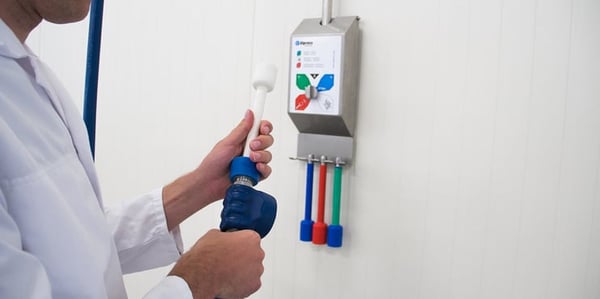
With modern cleaning systems (and possibly in combination with eCloud), you can gain insight into things that previously remained invisible, such as:
- Which function is used (rinsing, foaming, disinfection)
- How long each step takes (stand times)
- How much water and chemistry is consumed
- When there are deviations from normal behavior
- Where (which supply point/room) it happens
- Optionally: who did it (via RFID access)
The latter is often a gamechanger in practice. Not to control people as an end in itself, but to secure the process and achieve repeatable quality. Knowing that you can see back who did what also helps you follow procedures more seriously.
Insight also works preventively: behavior changes
When cleaning becomes measurable, behavior often changes by itself. Deviations become visible more quickly, conversations become more factual and procedures are followed more seriously.
You don't have to watch every night. Creating insight creates an environment where the process corrects itself better.
Does insight mean everything has to be automated?
No. Insight does not mean that manual controls become obsolete. Rather, it supports daily work. You see faster where adjustments are needed and become less dependent on paper, assumptions and incidents.
It is a practical step towards smarter organization of cleaning, without unnecessary complexity.
An optimal cleaning process for every company
Do you want to know where the biggest risks and opportunities are in your cleaning process and which steps you can take to gain insight and grip? Then download our white paper.